
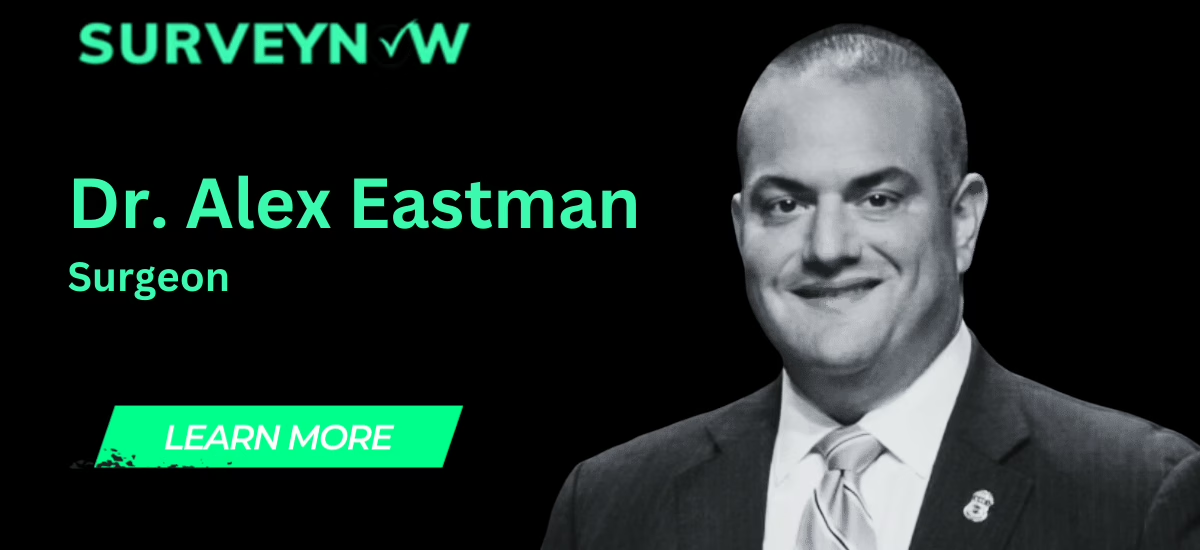
Few medical careers today so directly intersect trauma care, public safety, and national preparedness as Dr. Alexander Eastman’s. The combination of Eastman’s training as a trauma surgeon and his early work in emergency medical services (EMS) reflects a broader trend in the U.S.’s response to disasters, large-scale violence, and catastrophic injury.
For nearly two decades, Dr. Alexander Eastman has worked in spaces rarely discussed together: hospital trauma bays, law enforcement operations, pre-hospital response systems, and federal health security planning. Each space carries unique presumptions about risk, authority, and responsibility. Eastman’s work has been centered on understanding what occurs when those presumptions meet and when those boundaries slow the delivery of care rather than provide protection.
Eastman’s involvement in the Hartford Consensus, the creation of the THREAT response model, and national hemorrhage control training represent a persistent question, not a single solution. In which location does care truly begin? How much time is spent waiting for conditions that almost never develop during actual emergencies?
This interview will explore how Dr. Alexander Eastman’s experiences in trauma surgery, EMS education, and operational medicine have influenced his views on preparedness, ethics, and system design. Rather than providing prescriptions, it will examine the pressures that have pushed medicine closer to the site of injury and the unmet challenges that accompany that movement.
Interview with Dr. Alex Eastman
What first led you to prehospital care and emergency response?
Like a lot of people, it started early. I wanted to help in moments that actually mattered. I became a volunteer firefighter and later worked in EMS. Those experiences put real responsibility on me at a young age. You learn fast how important teamwork is. You learn how to make decisions when there’s pressure and no perfect answer. That stayed with me.
How did those early experiences shape your later work in medicine and trauma care?
They showed me something very clearly. Many outcomes are decided before a patient even reaches the hospital. What happens in those first minutes matters more than people realize. That’s where timing, communication, and awareness make the biggest difference. I carried those lessons with me through medical school and into my work as a surgeon.
You’ve worked in EMS, law enforcement, and surgery. How do those roles overlap?
Injuries don’t care about job titles. Emergencies happen in messy, unpredictable situations with a lot going on at once. Working in both EMS and law enforcement taught me that good care comes from coordination, not separation. Each role is important, but problems often arise during handoffs. That’s where delays creep in.
What problems did you see in traditional trauma response systems?
Time was the biggest issue. Many injuries were survivable, but care was delayed. Systems were built to wait until scenes were fully secure or conditions were ideal before treatment began. That sounds good on paper, but it doesn’t match reality. Violent and chaotic events don’t give you ideal conditions.
How did that change your approach to trauma education and response?
It shifted my focus from where care ends to where it actually begins. Training can’t just be about textbook medicine. It has to reflect what responders really face. Incomplete information. Limited resources. High stress. People need to be prepared to act before everything is clear, because waiting for certainty often costs lives.
What role does education play in improving outcomes during emergencies?
Education impacts a responder’s mental state as much as technical capability. Technical knowledge is important, but decision-making under pressure is even more important. Training that recognizes uncertainty and friction will better prepare responders for true emergencies. Small changes in preparedness can produce substantial positive changes in outcomes.
What problems arise when medical care approaches dangerous environments?
Ethical and practical problems arise as soon as medical care approaches dangerous environments. Problems regarding risk, neutrality, authority, and responsibility become far more complex. Developing protocols alone cannot solve these problems. Judgment, accountability, and ongoing self-evaluation are necessary.
How do you perceive the role of civilians in emergency response?
Often, the first person capable of assisting a victim is not a professional responder. Educating civilians in basic skills such as bleeding control acknowledges the reality of response versus idealized response models. It does not replace professional responders, but it does reduce preventable losses during critical minutes.
What has consistently remained the same throughout your career, regardless of the role you have taken on?
Reducing delay has remained the focus of my entire career. Regardless of whether I am working in EMS, surgery, education, or policy, the same question continually arises: where does care fail, and why? Answering this question requires examining the design of the overall system and not merely the performance of the individual.
How do you assess success in your line of work?
Success is frequently measured by what does not occur. The absence of preventable deaths is a key indicator of success. There are fewer instances of failures attributable to timing or coordination. Success is typically quiet and unnoticeable. Success appears as an absence rather than an occurrence.
What recommendations would you offer to those entering the field of emergency medicine or prehospital care?
Remain grounded in reality. Learn to function with incomplete information. Treat every position within the response continuum with equal respect. Remember that preparedness is a dynamic process and is subject to continuous assessment and revision as environments, threats, and systems evolve.
Conclusion
Alexander Eastman’s career shows how emergency response in the United States has changed over time. These changes did not happen because the system was carefully redesigned. They happened because the system was repeatedly pushed to its limits.
People repeatedly lost their way when help arrived too late. Those experiences forced doctors, first responders, and planners to rethink how emergencies are handled. Questions began to shift. Where should medical care actually start? Who needs help before professionals arrive? How fast do decisions need to be made when everything is unfolding at once?
One lesson has become clear across many settings. Waiting is often the primary cause of failure. Being nearby matters more than having the perfect credentials. And systems that work well in calm, organized conditions often struggle when chaos takes over.
These patterns show up in hospitals, in first-responder training, and in national emergency planning. When emergencies happen, success depends less on rules and titles and more on speed, coordination, and the ability to act before conditions are ideal.
The unresolved operational and ethical questions surrounding the provision of medical care in close proximity to danger remain unanswered. The introduction of medical care into high-risk/dangerous environments creates ambiguity, increases risk, and establishes accountability that cannot be effectively addressed by adherence to protocols. However, the consequences of delaying action until complete knowledge is available have repeatedly been shown to outweigh the risks associated with acting on incomplete data.
Dr. Eastman’s contributions to the evolving landscape of emergency response will be evidenced not by the existence of a particular program or framework, but by a fundamental paradigmatic shift in thinking. Medical care is no longer limited to endpoints; readiness is no longer abstract; and ultimately, the level of preparedness exists in direct proportion to the intentional design of systems prior to the next event, when time, rather than intent, will determine life and death.
Disclaimer: This article is for informational purposes only and highlights Dr. Alexander Eastman’s professional experiences and perspectives in trauma surgery, emergency response, and national preparedness. Dr. Eastman is a highly qualified trauma surgeon and expert in tactical medicine. The content is not intended to provide medical advice, treatment recommendations, or professional guidance.