

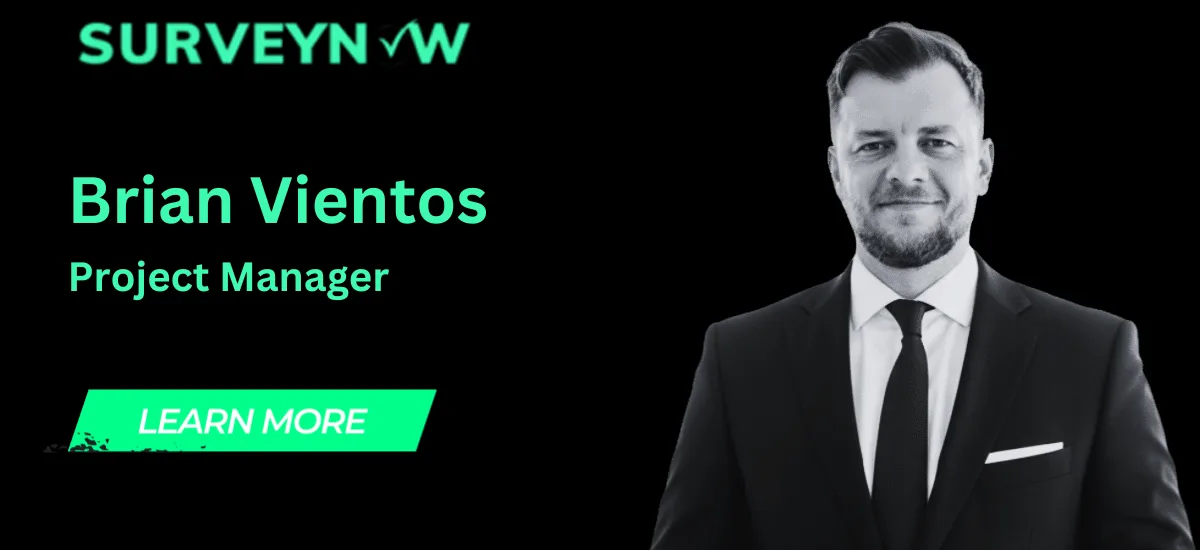
In capital project management, a 98 percent on-time completion rate is the kind of number that makes people assume the projects must be simple. Brian Vientos’s projects are not simple. They range from two to eight million dollars each, involve safety-critical construction, run on a seasonal deadline that cannot move, and unfold in an environment that continues serving millions of guests throughout the work. He delivers eight to twelve of them a year, on time 98 percent of the time, and an average of 7 percent under budget.
How? We looked at the career and the methods of one of New Jersey’s most consistent capital project managers to understand what actually drives those numbers. What emerges is less about any single technique and more about a specific philosophy of preparation built over two decades.
Who Is Brian Vientos?
Vientos is a certified Project Management Professional based in Jackson Township, New Jersey, who manages capital improvement projects for a major regional entertainment and attractions venue. He holds a Bachelor of Science in Business Administration from Monmouth University with a concentration in management, the PMP certification from the Project Management Institute, and a Lean Six Sigma Green Belt.
His path to project management is central to understanding his results. He did not enter the field through a construction or engineering track. He started in operations, spending nine years on the floor and in supervisory roles before moving into capital project management in 2017. That operational grounding is the foundation everything else is built on.
What Makes His Numbers Unusual?
To appreciate why a 98 percent on-time rate matters, it helps to understand the baseline. According to the Project Management Institute’s research, a significant share of projects across industries finish late, over budget, or both. The PMI Pulse of the Profession has consistently documented that project failure and budget overrun remain common across sectors, even among experienced teams using established methodologies.
Against that baseline, sustained delivery at 98 percent on time and 7 percent under budget is not a marginal improvement. It is an outlier. And outliers are worth studying, because they usually reveal something the standard playbook misses.
The Core Insight: Operational Experience Before Project Authority
The single most important factor in Vientos’s results is something that happened years before he managed his first capital project. He spent nearly a decade learning the operation he would eventually build for, from the ground up.
Most project managers arrive at a site with methodology but without context. They know how to build a Gantt chart, manage a critical path, and track a budget. What they often lack is a ground-level understanding of the environment the project lives inside: how the operation actually flows, where the friction points are, what a delay in one area does to everything downstream, and how the people executing the work think.
Vientos has that context because he earned it. Industry peers point to it directly. As one colleague put it in coverage of his career by Business Journal, plenty of people can talk strategy in a meeting, but Vientos understands what actually happens once crews are on site, timelines tighten, and unexpected issues come up. That understanding lets him build plans that survive contact with reality, because they were designed by someone who knows what reality on that site looks like.
How Does Lean Six Sigma Factor In?
Vientos’s 7 percent average under-budget performance is where his Lean Six Sigma training becomes visible. Lean Six Sigma is a methodology focused on eliminating waste, reducing variation, and making decisions from data rather than assumption. Applied to capital projects, it shows up as disciplined resource management, early identification of inefficiencies before they become budget problems, and a systematic approach to keeping the gap between plan and execution as tight as possible.
The under-budget number is not the result of cutting corners. It is the result of removing waste. On a portfolio of projects each valued in the millions, a consistent 7 percent under budget represents a substantial amount of preserved capital returned to the organization year after year.
What Can Other Project Managers Learn From This?
Vientos’s career offers three transferable lessons for anyone in project management or operations leadership.
First, operational context is a competitive advantage that credentials cannot replace. A project manager who understands the environment they are building inside will consistently outperform one who only understands the methodology. When possible, time spent learning the operation from the ground up pays returns for the rest of a career.
Second, methodology compounds when paired with experience. The PMP gives structure. Lean Six Sigma gives process discipline. Neither produces outlier results on its own. Combined and applied by someone with deep domain knowledge, they produce a 98 percent on-time rate.
Third, consistency is its own skill. Vientos’s two Project Excellence Awards, earned in 2022 and 2024, reflect sustained performance rather than a single strong project. Delivering reliably, year after year, across a full portfolio, is a different and more valuable capability than a single impressive result.
The Takeaway
The most useful thing about the Brian Vientos case study is that the core insight is not proprietary. He did not gain an edge from a secret technique. He gained it from patience: from being willing to spend nine years learning an operation before taking responsibility for building inside it, and from pairing that hard-won context with formal methodology applied consistently over time.
In a field full of professionals looking for the shortcut, the most accomplished practitioner in the room is often the one who took the long way on purpose. That is the finding worth taking from his numbers.
For more professional profiles and analysis, explore SurveyNow’s Interview and Case Study sections. Connect with Brian Vientos on LinkedIn.
